The problem
Five idle machines and one that renders all night.
The render sits on one workstation for six hours while every other machine in the building does nothing. Everybody knows this, and everybody lives with it, because the answer has always been a render farm: a server, a database, a service running on each machine, and somebody whose job is to keep all of it alive.
On a show, nobody has that somebody. You are rigging, you are cutting, you are delivering. So the farm never gets built and the workstation keeps rendering all night.
The answer
The shared folder is the server.
Presto has no central component. Submit a comp from the panel inside After Effects, it is cut into parts, every machine running Presto takes the work it can take, and one of them assembles the finished segments into the final file.
Open the app on a machine, point it at the folder, press start: that machine is now part of the farm. Close it and it is not. There is no node to register, no port to open and no administrator to ask.
The principle
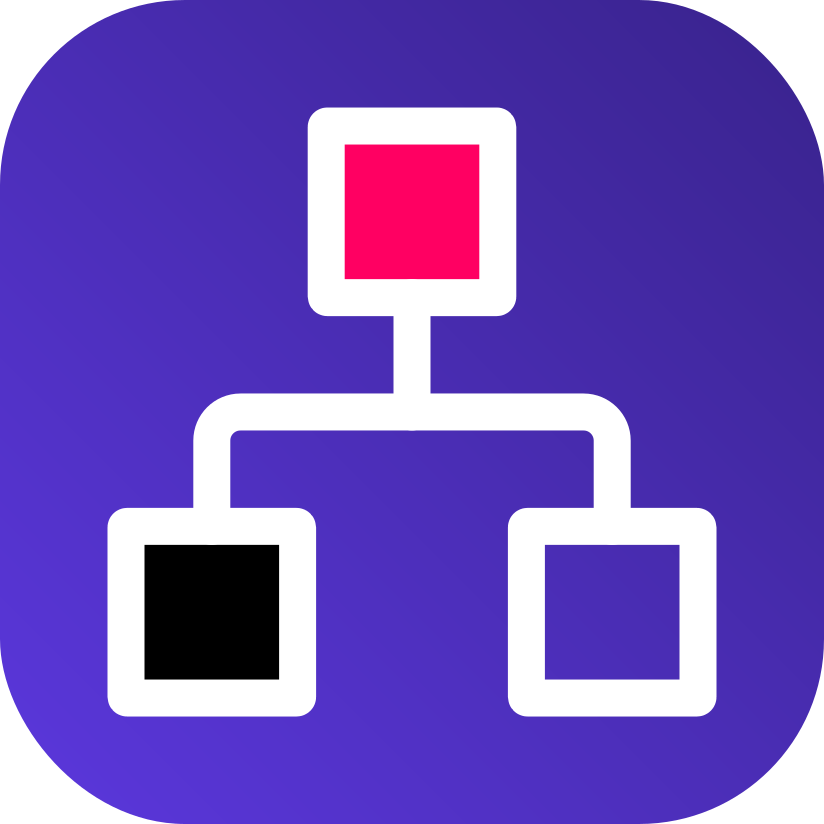
Nothing on this diagram is a Presto component.
The switch is your switch, the NAS is your NAS, and the folder is a folder. The only thing Presto adds is an app on each machine. Coordination happens inside the shared folder: each part is a file whose name carries its state, and a machine taking a part simply renames it. A rename either happens or it does not, which is the one operation every network share on earth already performs reliably.
Add a machine to the drawing and it joins the render. Take one away and the rest carry on.
Key features
What it actually changes for you.
Keep working
The render leaves your machine and runs on the others, from a frozen copy of the project taken at submission. Each machine chooses its roles, so a workstation in use can still lend a hand.
More machines, more power
Need it faster tonight? Open Presto on another machine and point it at the same folder. It joins the job already in progress.
Mac and PC together
The Mac suite and the Windows machines in the truck work the same job at the same time. A part rendered on Windows is combined on a Mac without anyone thinking about it.
Installed in two minutes
One app per machine, one folder to point at, one button. Nothing to stand up, nothing to maintain, no administrator rights to beg for.
Built to survive the night
A machine that crashes, a laptop that walks out, a share that drops: the job carries on and the lost part goes back in the queue. Whatever fails says which machine and why, and your phone gets a push on delivery and on failure.
Knows which machine is fast
Work goes to the machines that will deliver soonest, render speed and write speed to the share counted together, learned from real jobs. A machine slow enough to hold everyone up steps aside on the last parts.
Nothing leaves the building
The project, the media and the finished file never go near a third party. No upload, no account, no cloud storage holding an unreleased show.
Movie files out
The final file is the file you asked for, assembled automatically. No image sequence to babysit and no manual pass at the end.
Live network monitor
A standalone dashboard published to the share, readable in any browser, on any screen in the building. Red means an error and nothing else.
One detail that decides more evenings than raw power: a part is not finished when After Effects stops, it is finished when the file has landed on the share. Thirty gigabytes travel in thirty-three seconds over ten gigabit and in seventeen minutes over Wi-Fi. A laptop on Wi-Fi and the same laptop on Ethernet are not the same machine, and Presto does not score them the same.
Where the others stop
Everything else shares out jobs. Presto shares out one comp.
Event work has its own weight class: LED wall resolutions, HAP, NotchLC or ProRes, deliverables measured in tens of gigabytes. Anything that answers a render problem by moving those files somewhere else has already lost.
What each one actually does
- Render Brain. Easy, cheap, and the right answer when ten comps are waiting: it hands a whole render item to each machine. One comp still stays on one machine, so a three hour render is still a three hour render. The pool is metered too, two to twelve machines depending on the plan.
- Studio render managers. These do split a comp and run on your own network. They also want a server, a repository, a service on every machine and somebody to keep it alive, which is a pipeline department. And what comes out is a sequence of still images.
- After Effects on its own. Adobe is explicit: several machines cannot produce one movie file together, only a sequence of still images. Hundreds of files crossing the share, then a second pass to assemble them.
- Cloud render farms. Upload eighty gigabytes of ProRes from a venue, over whatever connection the site provides, and download it before doors. The maths does not work, and it means handing an unreleased show to a company you have never met.
- RenderGarden. The reference for years, and gone: its maker wound the company down. Free and unsupported is not something to build a delivery on.
| Presto | Render Brain | Render managers | After Effects | |
|---|---|---|---|---|
| One comp split across machines | Whole jobs only | |||
| Comes back as a movie file | Image sequence | Image sequence | ||
| Machines included | Unlimited | 2 to 12 by plan | Unlimited | Unlimited |
| No server to install or maintain | Server required |
Render Brain is the tool to reach for when the queue is long. Presto is the one for when the clock is short.
Availability
Coming soon.
Presto is in daily use on a live event pool of Mac and Windows machines, and it is being finished with that pool as the test bench. It is not downloadable yet.
If your machines spend their nights idle while one of them renders, say so and you will hear about it the day it ships.